Author Archives: quincycan

QCAN electric vehicle buyer survey

According to Pew Research, roughly 40% of Americans say they are likely to “seriously consider” an electric vehicle (EV) the next time they purchase a car. EVs are becoming more popular and could possibly overtake internal combustion engine vehicles in the near future. The subject of EVs has not escaped the gravity pull of polarization: the same survey showed that the opinion of electric vehicles skews along the lines of political affiliation, age, and location (with urban residents favoring EVs more than suburban or rural residents).

We noticed a spike in EV ownership among QCAN members at a recent meeting, and decided to ask our EV owners a little about their experience owning and using their EVs.

Congrats on getting an EV! What did you get?
Joe: Subaru Solterra
Julie: Nissan Leaf
Mike and Cyndy: Mitsubishi Outlander
Sarah: Nissan Leaf

What made now the right time to get an EV?
All: The price came down.

Most respondents mentioned that the combination of government rebates and price drops from the dealers brought these cars into an affordable range. This speaks volumes about the importance of state and federal governments’ ability to quicken the adoption of eco-friendly transportation.

What were your concerns before making this purchase?
Several people mentioned charging anxiety, and some felt that it was with good reason. Sarah mentioned that she was concerned about charging on trips and found that it was tricky as she feared. However Joe finds that charging has been way easier than he feared; he didn’t even know the seller would send him home with a charger that plugs into a wall outlet.

Julie had a preconceived notion that EVs were prohibitively expensive but was thrilled that her family was able to purchase the Nissan Leaf for about $21k after rebates.
Continue reading

In data: How heat pumps can cut carbon and fight climate change

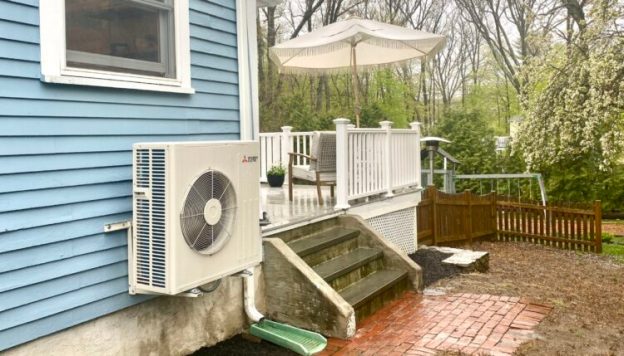
We installed a mini-split heat pump in our home in 2021 — not a whole-home system, just one wall-mounted unit in the living area, because that was all we could afford at the time. (The rebates are much, much better now — you can get $10,000 back from MassSave, plus up to $2,000 in federal tax credits.) And now that we’ve used our heat pumps for a couple of winters, I decided to analyze our heating history to see what kind of carbon impact they’re having, using 10 years of real-world data from our home. 

Long story short? Simply supplementing our gas boiler with a mini-split heat pump has cut our carbon emissions by almost 4 tons a year — more than if we took our car off the road entirely.

While our heat pump is really just a supplemental heat source — we have one wall-mounted mini-split head in the main living area, not one in each bedroom and the kitchen as you’d want for a complete conversion — we used it almost exclusively last winter, only turning on our gas boiler on the very coldest single-digit days for a little boost. (It’s been glorious in the summer, too, quietly replacing three noisy, inefficient window air conditioners.) 

I recently pulled our usage history from National Grid, just out of curiosity. It goes back 10 years, to when we had oil heat, providing a good baseline for our average winter gas usage minus heating; before we converted our boiler from oil to gas, we used about 24 therms a month in winter for hot water and cooking. 

Continue reading

Concerns with Granite Links lease extension request

Quarry Hills Associates (QHA), the private developer of the Granite Links Golf Course, currently has a 50-year lease with the City of Quincy for 540 acres of city property.

With more than 20 years remaining, important recreational and environmental provisions of the current lease have not been honored. Nonetheless, QHA is requesting a 99-year lease extension for investment/development purposes, which would require a Home Rule Petition that is typically granted only for non-profits or air rights/utilities.

Concerned with the lack of serious fiscal transparency, a closed-door process that has not sufficiently engaged affected residents, and recreational and environmental issues, a group of citizen activists, environmentalists, and attorneys formed the Quarry Hills Citizen Advocates and has amassed a compelling case against the proposed lease extension. This land is zoned as the largest piece of open space in Quincy and many feel it should be available to all residents for sports events, walking, reasonably priced golf, etc. There are also concerns about traffic issues, access to and maintenance of the Ricciuti Drive ballfields, and the lack of appropriate public trail access to the Blue Hills Reservation that was required in the original lease.

Time is of the essence, as mayoral and city council elections take place November 7 and could directly affect the outcome of this once-in-a-lifetime home rule vote. For some background, an interview with attorney members of the group is available here.

Mike Cotter and Cyndy Roche-Cotter, QCAN members

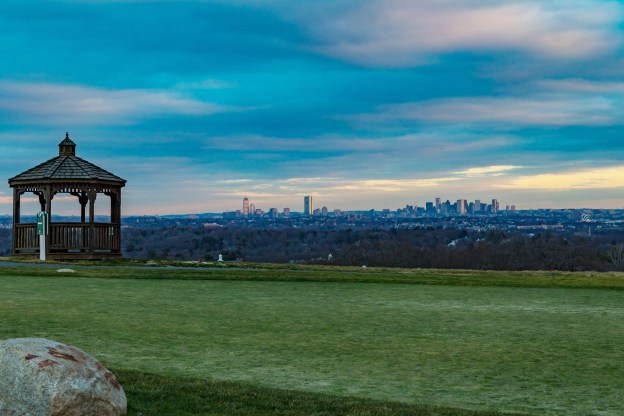
image: Boston skyline at sunset from Granite Links, by Eric Moreno (CC BY 2.0 DEED license, color adjusted)

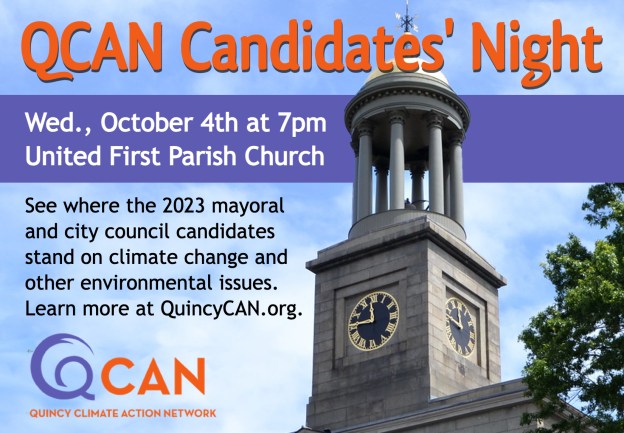
Save the date: QCAN Candidates’ Night Oct. 4, 7pm

It’s election season in Quincy! This is a big year with a contested mayor’s race.

At QCAN we want to know where our candidates stand on environmental issues. So on October 4th at 7 pm we will be hosting our 2023 QCAN Candidates’ Night. This year we are happy to return to a live format at United First Parish Church (President’s Church in Quincy Center) as we did before Covid.

We have confirmed participation from mayoral candidates Thomas Koch and Anne Mahoney; city councilor candidates Dave McCarthy (Ward 1), Anthony Andronico and Richard Ashe (Ward 2), James Devine and Matthew Lyons (Ward 4), and Bill Harris and Deborah Riley (Ward 6); and at-large city councilor candidates Scott Campbell, Noel DiBona, and Nina Liang.

Please help spread the word and share the Facebook event.

We look forward to seeing you there!

Let’s head towards net zero with the Opt-In Specialized Code

At its May 15 meeting the Quincy City Council passed a resolution asking the mayor to pull together a group to review the city’s current stretch code and assess the benefits and burdens of adopting the state’s new specialized stretch code. This group will include several city departments as well as Shelly Dein, Director of Energy and Sustainability, and nongovernmental people. QCAN hopes to be involved in this group.

The Opt-in Specialized Code provides stricter requirements on the use of gas and fossil fuels for heating and cooking to encourage new construction to go “all-electric.” There will be financial and environmental benefits for residents, public projects, and private projects.

The matter has been referred to the city council’s Environmental & Public Health Committee and Community Engagement Committee. It will be important to let our city councillors know that we are looking forward to making progress on this initiative.

The Stretch Energy Code (Stretch Code) is an additional energy code requirement on top of the Massachusetts “base” Energy Code. The Stretch Code is designed to promote energy efficiency and reduce greenhouse gas emissions in new construction and substantial renovations. The New Buildings Institute describes it as a “locally mandated code or alternative compliance path that is more aggressive than the base code, resulting in buildings that achieve higher energy savings.” One of the benefits they cite is that a Stretch Code can align many of the relevant market actors: “Through making future base code requirements known in advance, it provides tremendous motivation to manufacturers and distributors to compete for future market share of what will ultimately be required products.”

– Keith Johnson, QCAN board member

image: Jacobs School of Engineering, UC San Diego (CC BY-NC-SA 4.0)

Ward 4 Councillor candidates on climate change

Councillor Brian Palmucci resigned as Ward Four City Councillor after accepting a nomination to become an associate justice of the district court. This vacancy means the city will hold a special election to fill this seat for the rest of the unexpired term. Because more than two people have returned papers, there will be a preliminary special election Tuesday, Jan. 17. The election to pick a new councilor will take place Tuesday, Feb. 7.

QCAN would like to know, and would like voters in Ward 4 to know, how these candidates plan to help fight climate change in our city. We posed the following question to the four candidates:

“If elected to finish out this term, what would you like to do with your time on city council to fight climate change?”

As of January 3rd we received responses from Joel Buenaventura, Matthew Lyons, and James Devine.

Joel Buenaventura  (via email):

I am a proponent of “Think Globally, Act Locally.” We know climate change is real and Quincy, a coastal city in an urban environment, is particularly vulnerable to the impacts of air pollution and rising sea levels. 

For the remainder of the Ward 4 Councilor’s Term in 2023, I will continue the conversation with the Administration:

  • Food waste collection at QPS and curbside food waste pick-up.
  • Forestry Division in the development of the urban canopy. Ward 4 hosts the largest concentration of trees in the City. I want to make sure trees and tree health is maintained.
  • To inquire on Pine Hill Cemetery Expansion and environmental impacts.
  • To promote participation in the 34th Annual Cleaner, Greener Quincy in the spring of 2023 with my Ward 4 neighbors.

I hope that the above bullet points are just a start to our conversation. As Councilor, I would also like to expand on (1) sustainability, (2) net zero emissions, (3) climate resilient infrastructure and operations. I look forward to attending your meetings and hearing from your members about your most pressing concerns. 

Matthew Lyons (answered via facebook comment):

Coastal resiliency, ensuring city infrastructure is being planned in a way that accounts for sea level rise and climate change. Ensuring that city building codes are progressive without raising costs for working families.

Devine for Ward 4 (answered via facebook comment):

I believe we still need to work on the opt-in stretch code, if so I would like to see more. Another item is the compost task force, reclaiming organic waste. This hits two levels one we have less weight in trash pick up which saves money on our budget and second we can produce our own soil, saving tax payers money twice. I apologize for the brief comments. This is a fast pace to prove my worth to be a Councillor for Ward 4, and many more items to answer and conquer.

City to begin food waste collection in schools

Plans are nearly complete for a new food waste collection program in the Quincy Public Schools. The program will begin as a pilot at one school this fall, expand to a second school in the spring, and continue to expand into more schools. The next step in the process is to hire a part-time K-12 Food Waste Diversion/Compost Program Manager, who will be tasked with managing the operation, conducting waste audits, and creating educational programs for students and staff. Applicants should apply online.

QCAN has encouraged the implementation of food waste collection for years. Several QCAN members served on the mayor’s task force created in 2018 to research curbside food waste pickup. The task force engaged in many fact-finding activities, including conducting interviews and onsite visits to learn how other food waste collection programs function. The results of their extensive research were compiled in a report that was submitted to the mayor’s office this spring and is tentatively scheduled for presentation to the City Council on November 21. Their report supports collecting food waste not only in the schools, but city-wide, as is done in Cambridge and several other towns and cities in the commonwealth.  

Why collect food waste separately? Quincy’s trash is sent to an incinerator and burned as waste for energy. However, due to the high water content of food waste, burning it uses more energy than it creates — and that moisture also makes it heavy, adding extra expense to the city’s trash bill. Collecting and composting food scraps instead of throwing them out is a better alternative that benefits everyone, including the planet. It not only reduces how much the city will pay for trash removal, it puts the food waste to work, reinvesting those nutrients into our increasingly depleted topsoil. Food scraps can be made into compost that feeds our gardens so we can grow more food. How cool is that?

Continue reading